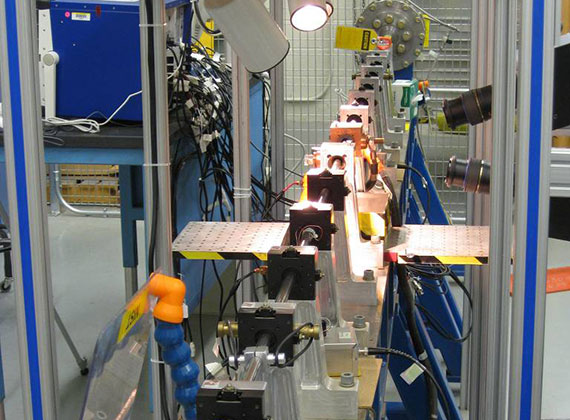
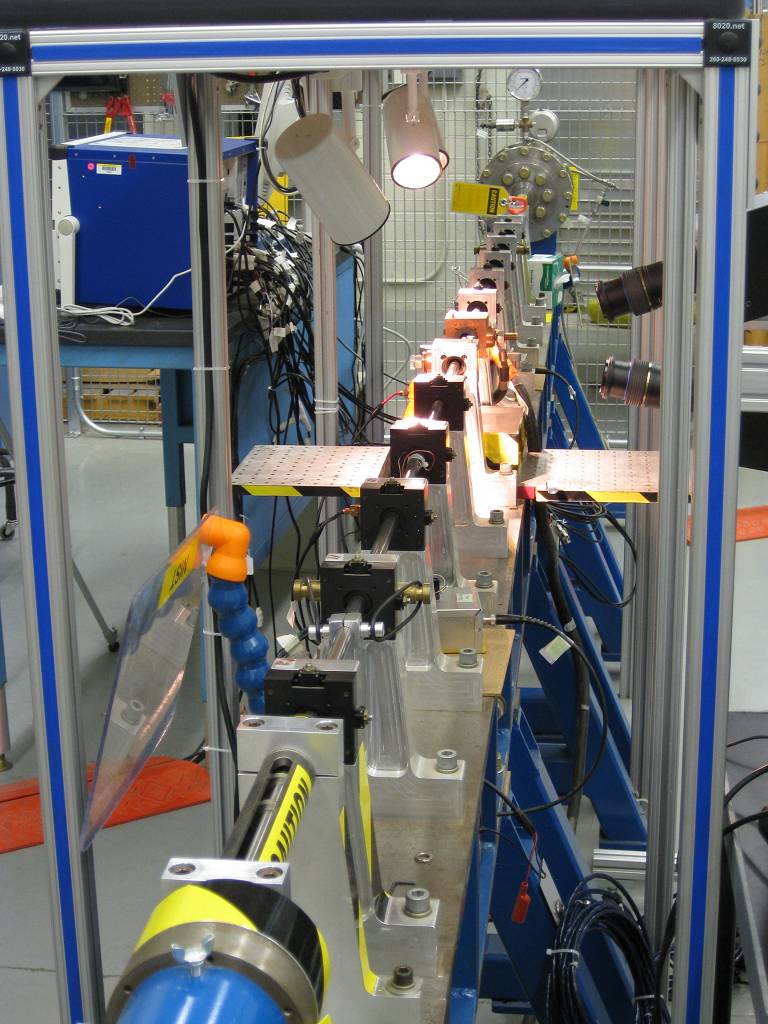
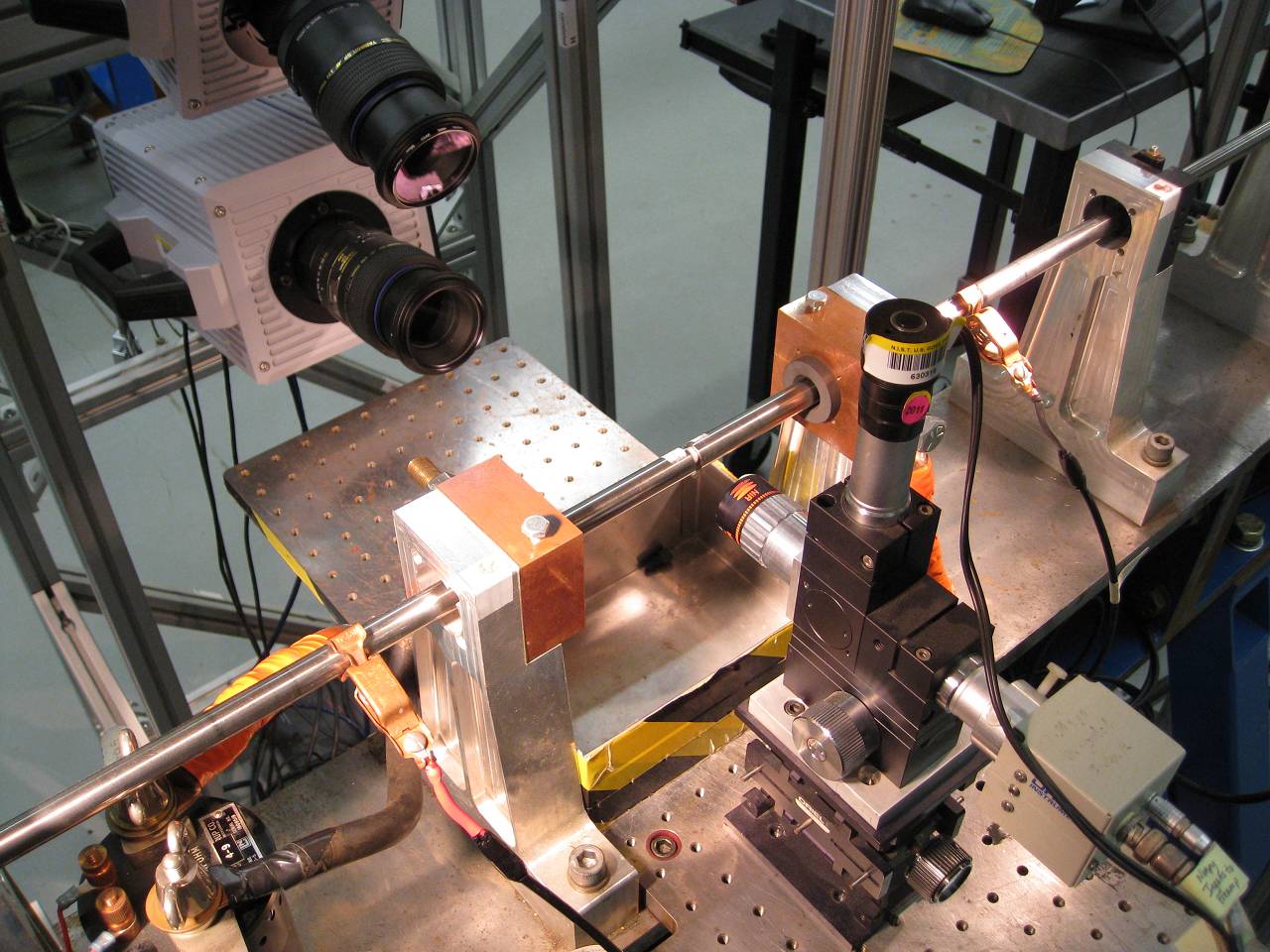
To ensure that all of these requirements could be met, NIST developed an integrated software system called the Split Hopkinson Bar Data Processing And Distribution System (PADS).
HBM’s
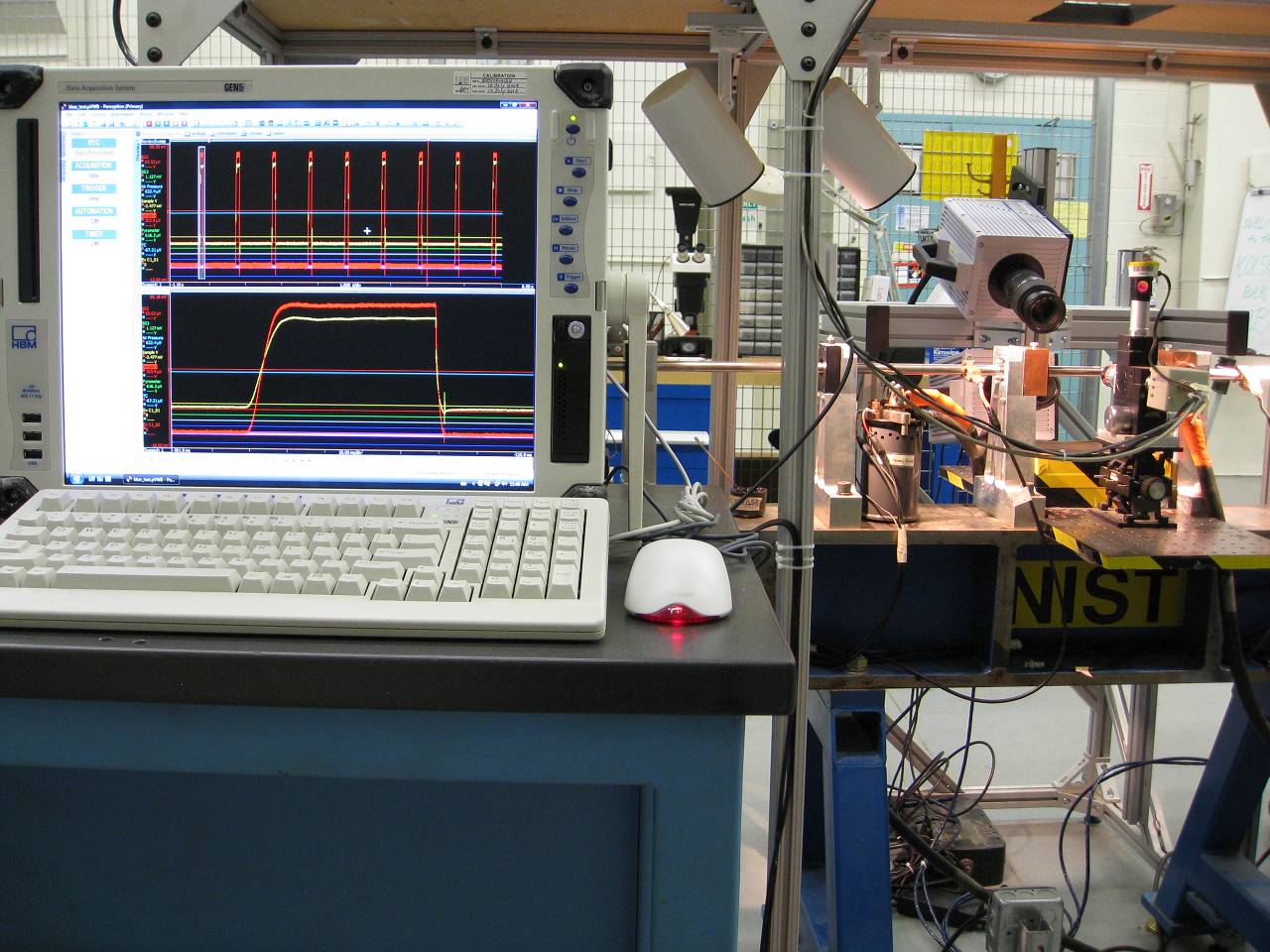
Genesis HighSpeed data acquisition equipment supplies Split Hopkinson Bar measurement data to Data PADS. HBM was able to meet NIST’s requirements because the Genesis HighSpeed is a robust DAQ system capable of capturing all of the relevant data from the three key points during the test –
- the initial compressive impact,
- the reflected compression stress wave
- and the ongoing tensile wave –
in the very short space of time available. This, combined with HBM’s international metrology expertise, means that it could provide all of the sensor, data acquisition and data processing equipment needed by researchers wishing to build similar systems – from strain gauges through to the analysis software.
An advantage of HBM’s Genesis HighSpeed DAQ is that it can also accurately record the low amplitude voltage because it is fitted with a high speed A/D board. The DAQ system needs to have a high frequency response to record the signal that usually lasts less than one millisecond. Generally the minimum frequency response of all components in the data acquisition system should be 2 MHz for strain gauge data and 100 kHz for heating data.
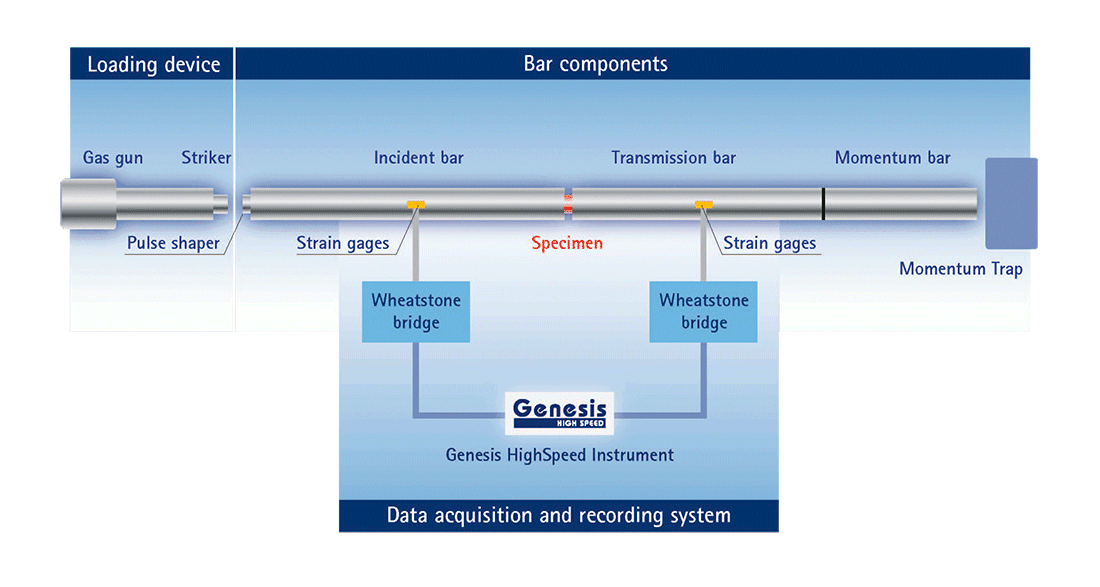
Strain gauges have evolved as the standard technique to measure bar strains in the NIST Split Hopkinson Bar experiments. Usually two strain gauges are attached symmetrically on the bar surface across the bar diameter. With strain gauges mounted at the midpoints of the Incident and Transmission Bars and using one-dimensional elastic wave analysis, the sample’s stress against strain response can be obtained. The signals from the strain gauges are conditioned with a Wheatstone bridge. Typically the voltage output from the Wheatstone bridge in these experiments has small amplitude of the order of millivolts.
The two sets of standard linear strain gauges are arranged in a full bridge circuit. The upstream strain gauges have a dual purpose because they measure the incident strain on the material and the reflected strain that is returned from the loading pulse in the equipment striking the sample. The downstream strain gauge records the transmitted strain that is passed through the material and into the second section of the NIST Split Hopkinson Bar.
Another advantage of the Genesis HighSpeed DAQ equipment is that it is easy to use and the software can easily be modified to meet the particular needs of any application. The combination of Genesis HighSpeed data acquisition equipment with HBM’s knowledge of strain and strain gauges enable HBM to provide customers a unique combination of expertise.