
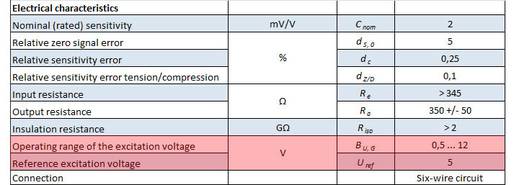
 2.5 and 10 V. The right value for your force transducer can be found in the data sheet; see 'Operating range of the excitation voltage'.
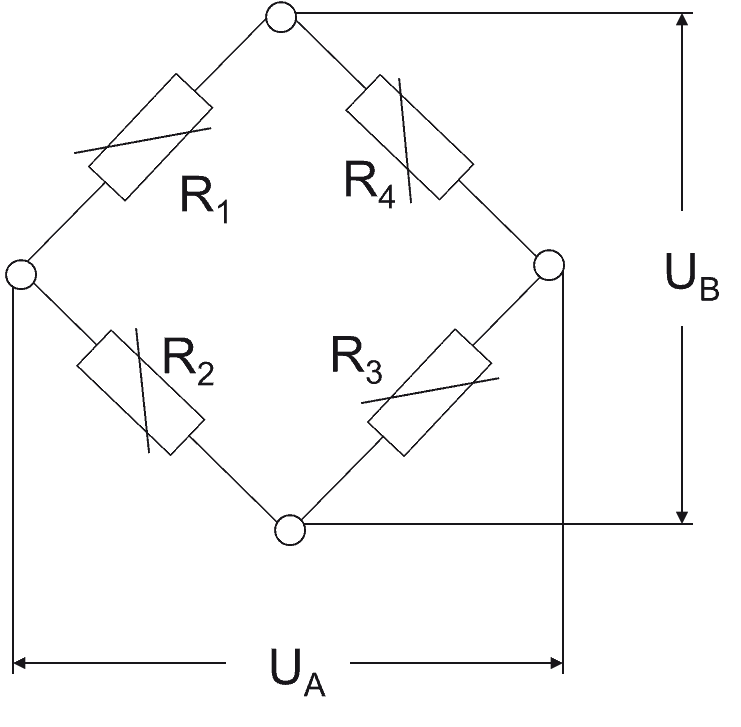
The above circuit diagram shows that four leads are sufficient to operate a Wheatstone bridge. Two leads supply the sensor with electric voltage, the other two leads feed the amplifier with the measuring voltage.
2.5 and 10 V. The right value for your force transducer can be found in the data sheet; see 'Operating range of the excitation voltage'.
The above circuit diagram shows that four leads are sufficient to operate a Wheatstone bridge. Two leads supply the sensor with electric voltage, the other two leads feed the amplifier with the measuring voltage.
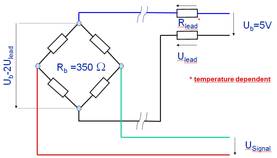 Strain gauge measurement technology requires a minimum of four wires to be connected. Many sensors work according to this principle, which is called four wire circuit. This configuration is shown below.
The lead resistances are drawn in the supply leads. These resistances are to show that the lead resistance must not be neglected.
Strain gauge measurement technology requires a minimum of four wires to be connected. Many sensors work according to this principle, which is called four wire circuit. This configuration is shown below.
The lead resistances are drawn in the supply leads. These resistances are to show that the lead resistance must not be neglected.
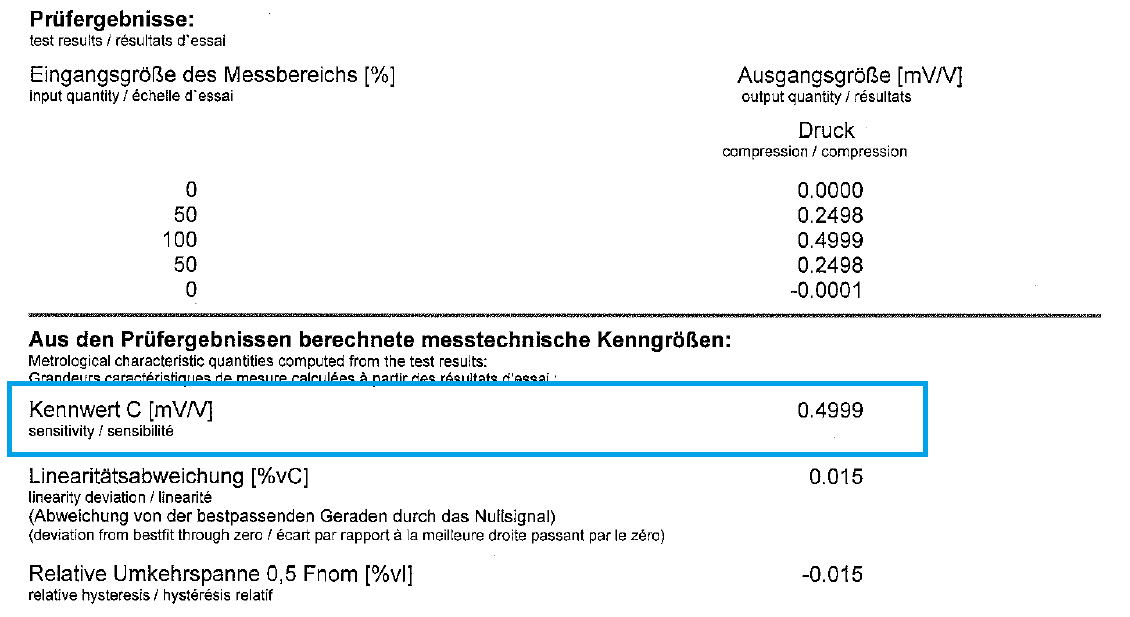 A test report provides a lot of information. The sensitivity is an important value enabling you to set up the amplifier. Example: U93/1kn force transducer
The cables running to the amplifier input need not be taken into account. Since modern amplifiers use high-resistance input stages, the voltage drop in these lines can be neglected.
A test report provides a lot of information. The sensitivity is an important value enabling you to set up the amplifier. Example: U93/1kn force transducer
The cables running to the amplifier input need not be taken into account. Since modern amplifiers use high-resistance input stages, the voltage drop in these lines can be neglected.
 Many sensors use the six wire circuit. They use two additional leads controlling the excitation voltage at the bridge. Should the cable resistance vary as a result of temperature influence or a change in cable length, the amplifier makes internal readjustments until the setpoint value is reached again.
The advantage of this circuit is that you can use very long cables (up to 500 m) without the sensors' sensitivity being affected. Lead resistance variations caused by temperature variations also do not impact the measurement result.
This is particularly advantageous when the cable temperature and the temperature of the force transducer are not identical.
Many sensors use the six wire circuit. They use two additional leads controlling the excitation voltage at the bridge. Should the cable resistance vary as a result of temperature influence or a change in cable length, the amplifier makes internal readjustments until the setpoint value is reached again.
The advantage of this circuit is that you can use very long cables (up to 500 m) without the sensors' sensitivity being affected. Lead resistance variations caused by temperature variations also do not impact the measurement result.
This is particularly advantageous when the cable temperature and the temperature of the force transducer are not identical.

This will bring together HBM, Brüel & Kjær, nCode, ReliaSoft, MicroStrain and Discom brands, helping you innovate faster for a cleaner, healthier, and more productive world.
