변형률
변형률 게이지(변형계)는 더 우수하고 안전한 제품을 만들기 위해 재료의 피로도를 측정하고 시험하는 데 있어 핵심적인 도구입니다. 구조적 내구성 테스트,구조 상태 모니터링, 또는 OEM 트랜스듀서 생산을 위해, HBK의 광학 및 전기 스트레인 게이지를 첫 번째로 선택해야합니다.
Read More

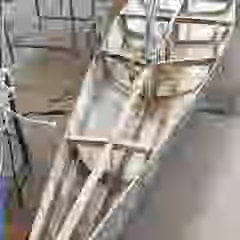
This study has been carried out within a framework of research activities regarding the innovative design and manufacturing of a small sailing yacht (called LED - Linen Epoxy Dinghy). These activities have been performed at the Dipartimento di Ingegneria Chimica, Gestionale, Informatica e Meccanica of the University of Palermo, in cooperation with the Facoltà di Ingegneria e Architettura of the University of Enna Kore.
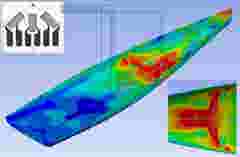
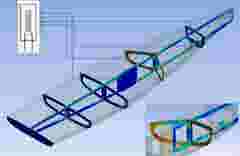
The purpose was to evaluate the strain field of a 15' SKIFF type sailing yacht by using strain gauges, and compare the experimental evaluation with the prediction of a Finite Element Method (FEM) model. Due to the application of the load system, FEM results obtained from preliminary numerical simulations identified the most critical deformed areas, located in the hull (fig.1), and in transversal and longitudinal internal stiffeners (fig.2).
The hull material is in particular a sandwich structure composed by Flax Reinforced Plastic skin laminates and by agglomerated cork as core. Strain components were measured on the internal skin of the hull, by means of four three-grid rosettes HBK type RY81-6/350, and a thermal compensator rosette. The sites of maximum normal strains on the transversal and longitudinal stiffeners of the yacht (made of marine plywood), were also considered, by installing four single-grid HBK strain gauges, type LY11-6/350 and a thermal compensator strain gauge.
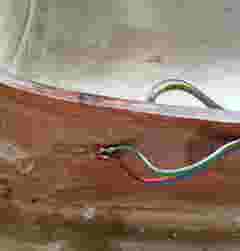
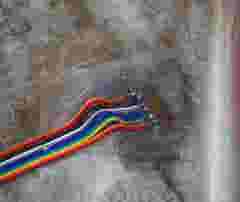
Each single grid in all installations was wired up by using a four-wire scheme, and protected with polyurethane paint from HBK type PU140 and a silicone sealing layer from HBK type SG250 (fig.4 and 5).
A load configuration was reproduced in the lab, simulating a loading scenario acting on the boat during typical sailing conditions (fig.1).
The measurement of strain gauge signals was carried out using Wheatstone bridges. The acquired signals, sampled over a time window sufficient to achieve a stabilized behavior, were then processed to obtain the complete strain state and to compare it with equivalent numerical FEM results.
The matching of experimental and numerical results was very satisfactory, allowing us to conclude that the FEM model is reliable. Moreover, the confidence gained about the reliability of the measured data, has opened the way for an experimental campaign of on-site measurements, during real sailing conditions. This procedure will require the connection of a strain gauge controller with a transponder and a GPS system.
The researchers:
More about University of Palermo
The researchers: