관성 측정 장치(IMU)
마이크로스트레인 IMU 제품군은 멀티 액시스 가속도계, 자이로스코프 및 경사계 통합하여 공간에서 물체의 방향을 정밀하게 추정하는 고성능 관성 측정 장치로 구성됩니다.
이 장치들은 까다로운 동적 환경에서도 탁월한 정확도로 가속도, 각속도 및 경사각 데이터를 직접 측정합니다.
Read More

마이크로스트레인 IMU 제품군은 멀티 액시스 가속도계, 자이로스코프 및 경사계 통합하여 공간에서 물체의 방향을 정밀하게 추정하는 고성능 관성 측정 장치로 구성됩니다.
이 장치들은 까다로운 동적 환경에서도 탁월한 정확도로 가속도, 각속도 및 경사각 데이터를 직접 측정합니다.
마이크로스트레인 VRU 제품군은 정밀한 경사 추정 및 플랫폼 방향 설정이 필요한 애플리케이션을 위해 롤, 피치 및 요를 측정하는 고급 수직 기준 장치로 구성됩니다.
마이크로스트레인 IMU 센서의 검증된 모든 기능을 기반으로 VRU는 확장 칼만 필터를 통합합니다.
자세 방위 참조 시스템 (AHRS)은 다축 가속도계, 자이로스코프 및 자기계를 통합하여 공간에서 물체의 방향을 추정하는 장치입니다. 피치, 롤, 요 측정값은 일반적인 데이터 출력입니다. MicroStrain의 AHRS 관성 센서는 로봇 공학 및 무인 차량 내비게이션에 널리 사용됩니다.
특징
출력

마이크로스트레인 센서는 항공우주, 로봇공학, 방위산업 및 산업 자동화 분야에 첨단 관성 항법 솔루션을 제공합니다. 당사의 포괄적인 제품 라인에는 독립형 INS 모델과 통합 GNSS/INS 솔루션이 모두 포함되어 있어 고객의 고유한 애플리케이션, 통합 및 성능 요구 사항에 맞는 이상적인 시스템을 선택할 수 있습니다.

인터페이스 케이블, 개발 키트, 장착 하드웨어 및 원활한 통합과 최적의 성능을 위해 자주 필요한 기타 품목을 포함하여 관성 센서 구현을 지원하는 필수 구성 요소입니다.
Inertial sensors are powerful devices that use accelerometers and gyroscopes to measure and report an object's motion. From simple tilt sensing to full-scale autonomous navigation, inertial sensors provide the critical data needed to control movement and orientation in space. MicroStrain inertial sensors are built using Micro-Electro-Mechanical Systems (MEMS) technology and are widely used in advanced motion systems, including robotics and autonomous systems.
The term Inertial Measurement Unit (IMU) is widely used throughout the industry. It can refer generally to any inertial sensor, but it also defines a specific product class. A foundational IMU provides raw, fundamental motion data. In contrast, more advanced systems – such as a Vertical Reference Unit (VRU), Attitude and Heading Reference System (AHRS), or Inertial Navigation System (INS) – integrate additional sensors and sophisticated filtering for complete orientation and navigation solutions. These systems are also used as inertial sensors for GNSS-denied navigation, helping maintain robust motion and position accuracy even when satellite signals are limited or unavailable.
To help you find the right fit for your project, we have broken down our product types below. Each product type builds on the last, guiding you from the core sensor to a complete navigation solution.
An Inertial Measurement Unit (IMU) is the foundational sensor for understanding motion. It provides the essential raw data about an object's movement without external references.
A Vertical Reference Unit (VRU) builds upon the IMU by adding sophisticated internal filtering. The filter, MicroStrain's Auto-Adaptive Extended Kalman Filter (EKF), computes a stable orientation relative to the Earth’s gravity.
An Attitude and Heading Reference System (AHRS) advances the VRU by incorporating a magnetometer. This allows for a complete, stable 3D orientation, including heading.
An Inertial Navigation System (INS) expands an AHRS to provide a complete navigation solution that includes position and velocity, in addition to attitude and heading. In some cases, an INS model integrates a Global Navigation Satellite System (GNSS) receiver to provide a full position, velocity, and time (PVT) solution.

검증된 실적 및 업계 리더십
With over 25 years of experience in MEMS, MicroStrain sensors are trusted by leaders all over the world

실제 사용 환경에서 탁월한 성능
Consistently outperforms in dynamic conditions and harsh environments

상호 교환 가능하고 확장 가능한 아키텍처
Simple, cost-effective scaling from prototype to production

최고의 가격 대비 성능
Optimal balance of features, performance, and cost




InertialConnect is the latest software solution for MicroStrain inertial sensors. With InertialConnect, you can easily configure your sensors, adjust parameters, upgrade firmware, and deploy preconfigured parameter files. You can also verify sensor outputs with intuitive visualizations, including times eries data, position data, and statuses.
InertialConnect is compatible with both PC desktop and Linux operating systems, making it your go-to solution for precision and efficiency in inertial sensor management.

SensorConnect is the next generation in desktop sensing software.
From configuration of nodes and starting networks, to collecting and analyzing data in real-time, SensorConnect provides a modern, powerful experience with our Wireless, Inertial, and Displacement products.
Using our intelligent data collection and graphing algorithms, you are able to visualize massive amounts of data instantly, and then zoom in on points of interest just as fast.
Built in MathEngine functionality allows for both real-time and post-processed math, such as generating FFTs, averages, RMS, etc.
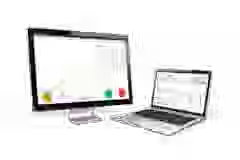
SensorCloud is a unique sensor data storage, visualization, and remote management platform that leverages powerful Cloud computing technologies to provide excellent data scalability, rapid visualization, and user programmable analysis.
MicroStrain sensors can instantly upload their data to SensorCloud via an ethernet-connected WSDA-2000. Once uploaded, your data is securely stored in the Cloud and can be accessed from anywhere, or downloaded for offline use.
Configurable alerts can be set to help notify you of real-time event in your data.
MathEngine allows you to perform analytics on your data, all in the Cloud. Pre-built functions are available for ease of use, while IPython Notebooks allow advanced users to write custom scripts to be run on their data once, or on a schedule.

SensorCloud RTK is a multi-continent, IP-based RTK cloud network that delivers centimeter-level position accuracy from day one without complex setup, featuring network coverage across the U.S., Europe and beyond.
When paired with compatible MicroStrain navigation systems, it offers seamless scalability from development to production with professional technical support throughout.
The MicroStrain Communication Library (MSCL) is our open-sourced API that simplifies writing code to interact with our sensors. MIP SDK is a lightweight C/C++ library for interacting with MicroStrain G and C-series products via baremetal and resource constrained microcontrollers.
Both APIs are readily available and fully-documented on GitHub, featuring valuable tools such as full documentation, example code, and a quick start guide.
Robot Operating System (ROS) is an open-source, meta-operating system for your robot. It provides the services you would expect from an operating system, including hardware abstraction, low-level device control, implementation of commonly-used functionality, message-passing between processes, and package management. ROS can be used in building and simulating robotics applications, as well as unmanned ground vehicles and simultaneous localization and mapping (SLAM). MicroStrain has an open source License free (MIT License) series of drivers specifically designed and tested for ROS.