변형률
변형률 게이지(변형계)는 더 우수하고 안전한 제품을 만들기 위해 재료의 피로도를 측정하고 시험하는 데 있어 핵심적인 도구입니다. 구조적 내구성 테스트,구조 상태 모니터링, 또는 OEM 트랜스듀서 생산을 위해, HBK의 광학 및 전기 스트레인 게이지를 첫 번째로 선택해야합니다.
Read More


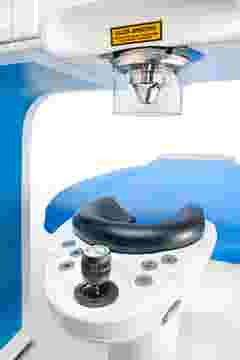
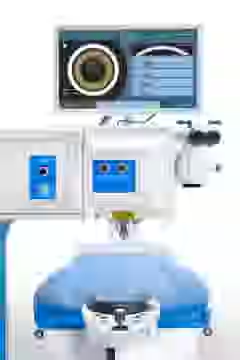
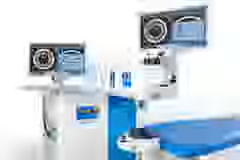

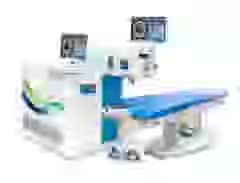
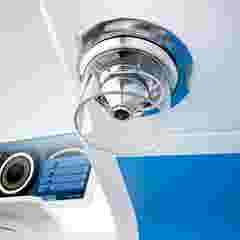
There can be no errors in operations with eye lasers: Because of this, the measurement technology used for the application must meet special criteria.
Manufacturer TECHNOLAS Perfect Vision trusts the reliability of the PMX amplifier from HBK in its devices, as this system consistently provides accurate measured values. Thus every incision of the eye laser is carried out at the exact position and to the correct depth.
The eye operation lasts only a few minutes. The physician does not need to use a blade. The patient can get up shortly after being treated and return home. The patient's visual abilities are restored quickly and without pain. Then the reading glasses can retire to a drawer.
LASIK operations are now performed more than 120,000 times a year in Germany. An excimer laser can be used to treat both nearsightedness and farsightedness as well as corneal curvature and even age-related farsightedness.
The technologies used include the TECHNOLAS® TENEO™ 317 excimer laser and the VICTUS® Femtosecond Laser Platform from manufacturer Technolas Perfect Vision, which belongs to the BAUSCH + LOMB Group.
One special feature of VICTUS® is that the system can be used almost universally. In addition to the wide range of applications for the cornea, cataract operations can also be performed. Ophthalmologists also appreciate the quality with which they can work. All the steps of an operation can be performed perfectly with the laser.
It is important while preparing for the LASIK operation for VICTUS® to work extremely precisely because the procedure presents great challenges for the technology. The laser cuts a small piece out of the cornea of the eye, referred to as a flap. The flap is then folded over so the cornea can be treated through the opening. After the operation the flap is folded shut again. It functions essentially as a natural patch.
The cornea of the human eye measures only 0.5 millimeters in thickness. The laser cuts the upper fifth of the cornea to a depth defined by the surgeon with µm prevision, then follows the curvature of the cornea with the incision. Great accuracy is essential in this area – the eye surgeon must always be certain of the exact position.
A sensor system that functions reliably is indispensable for this application. It is used for the purpose of connecting the laser device with the eye.
This is done with a "patient interface" consisting of two parts: a kind of contact lens that is drawn onto the laser, and a mounting clip that is drawn onto the eye.
The pressure with which the cornea is pressed against the laser through the patient interface is controlled exactly.
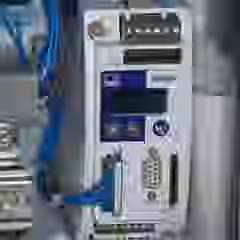
Strain gauges (SG) in the device indicate whether the pressure is constantly maintained. The PMX data acquisition system from measuring specialist HBK acquires the signals of the sensors and digitalizes them, thereby providing the eye surgeon who is performing the procedure with the certainty needed to work continuously in the correct tolerance range.
The PMX system ensures that the values needed by TECHNOLAS Perfect Vision GmbH are generated reliably.
Temperature stability is especially important in this regard.
Engineers from TECHNOLAS Perfect Vision were looking specifically for a manufacturer whose core business is measuring sensors, and for a system that comes from a manufacturing environment.
The PMX from HBK stands for both precision and reliability – thanks in part to the interference-proof HBK carrier frequency technology (CF) and automatic sensor detection via TEDS. The sample rate is 19.2 kilohertz per channel – for 16 measurement channels and 32 internal computing channels.
Thanks to the high measuring bandwidths, signals can be processed extremely rapidly.
In the VICTUS® , a three-fold redundant SG system records the signals and transmits them to the PMX. From there they are directed via a bus system to a computer – the "brain" of the system – for analysis.
Data is transmitted by a longer analog route within the VICTUS®. Normally that is not ideal, since every attempt is usually made to keep spatial distances short when analyzing analog signals.
The digitization should also be positioned directly on the sensors, but that was not possible for space reasons.
However, this was no problem for the PMX The amplifier returns reliable values despite the longer distance.
The safety functions provided by the amplifier are also important. Technolas experts developed a safety concept together with HBK that incorporates redundancies, watchdogs and other features to monitor how the components function.
HBK experts were informed how to implement parameterization so that the required results could be generated. The engineers of TECHNOLAS Perfect Vision concluded that the PMX is a highly flexible system that can be adapted to individual needs in many ways and everything worked out very well.
Work extends over a very wide pressure range. Good resolution is important for the entire range – if possible with low lateral forces. The engineers receive reliable data from the PMX system, and the provider's country of origin was also a factor in choosing the right system.
Technolas Perfect Vision wanted a tested system they could rely on, and the "Made in Germany" label was an important criterion for that requirement.
Technolas Perfect Vision GmbH, with its headquarters in Munich, is an internationally operating company of the Bausch Health Companies dealing with the development, production and distribution of ophthalmic medical devices. Our high-end laser systems and diagnostic devices are used for refractive, cataract and therapeutic eye surgery.
Founded 1985 in Munich with a focus on refractive excimer and diagnostic technology, Technolas was acquired by Bausch + Lomb in 1998.
In 2009, the excimer business was carved out from Bausch + Lomb to form a Joint Venture with 20/10 Perfect Vision, enlarging the portfolio by ophthalmic femtosecond lasers. The focus of this newly formed company called Technolas Perfect Vision GmbH was to expand from a purely refractive into the cataract and therapeutic business sectors.
In 2013, Technolas Perfect Vision GmbH was reacquired by Bausch + Lomb and by the end of that year both companies were part of the Bausch Health Companies.
For more information on the surgical portfolio, please visit bauschsurgical.eu.
변형률 게이지(변형계)는 더 우수하고 안전한 제품을 만들기 위해 재료의 피로도를 측정하고 시험하는 데 있어 핵심적인 도구입니다. 구조적 내구성 테스트,구조 상태 모니터링, 또는 OEM 트랜스듀서 생산을 위해, HBK의 광학 및 전기 스트레인 게이지를 첫 번째로 선택해야합니다.

다중 채널 데이터 수집 시스템은 실시간으로 측정 및 제어되며, 생산 공정과 품질에 이상적입니다. 특히 품질 관리를 위해 사용되는 시험대, 기계 및 공장에서의 측정 및 모니터링 작업에 적합합니다. 진단 및 설정을 위해 TCP/IP 인터페이스를 통해 사용하기 쉬운 웹 인터페이스가 제공됩니다.