MAIN MENU

Our customer is the world’s leading supplier of tissue-based cancer diagnostic systems for anatomic pathology. Its instruments and reagents automate tissue preparation and slide staining, helping pathologists diagnose cancer and other diseases. In high-throughput clinical labs, where diagnoses depend on rapid, accurate results, consistent system performance is critical. Its mission is to empower pathology professionals with standardized, high-quality testing solutions that improve the lives of patients with cancer.

usp-icon

Our customer faced unplanned downtime and performance variability in pathology diagnostic systems, with limited visibility into long-term reliability, failure drivers, and lifecycle risk—impacting lab efficiency and new product development.

usp-icon

By implementing HBK’s ReliaSoft Master Suite, engineering teams could proactively analyze risk, model system uptime, track reliability maturation during development, and predict long-term performance from accelerated test data.

usp-icon

This holistic Design for Reliability (DfR) program provides objective evidence of system robustness, accelerates product development with confidence, optimizes service strategies, and ensures the high uptime essential for modern diagnostic laboratories.

Meeting the Demands of High-Uptime Diagnostics

The "end-use customer" is a busy, high-pressure laboratory environment. The primary challenge was ensuring their complex diagnostic systems could meet the extreme demands for uptime and consistency, both for existing products and new ones in development.

The core issues were multifaceted:

1. The High Cost of Unplanned Downtime: A system that goes down unexpectedly can halt a lab's workflow, delaying patient diagnoses, wasting expensive reagents, and requiring costly emergency service calls.

2. Performance Variability: Inconsistent staining or mechanical failures can compromise the quality of a slide, potentially leading to diagnostic uncertainty and requiring time-consuming re-runs.

3. Limited Visibility into Long-Term Reliability: Predicting the long-term performance and total cost of ownership over a 5- to 10-year lifespan was challenging. This made it difficult to optimize service contracts, manage spare parts logistics, and accurately forecast lifecycle costs.

4. Inefficient Development Cycles: During new product development, it was difficult to know if the system's reliability was improving fast enough to meet launch targets. A late-stage discovery of a reliability issue could lead to major delays and redesigns.

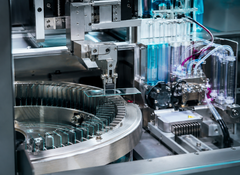
Precision diagnostic instrumentation

Engineering Reliability from Design to Deployment

To address these challenges systematically, we helped our customer implement a comprehensive Design for Reliability (DfR) program, using the HBK ReliaSoft Master Suite as its integrated analytical engine. This provides a "cradle-to-grave" approach to managing reliability.

1. Proactive Risk Assessment with XFMEA: The process starts here. For any new system or design change, engineers use XFMEA to identify all potential failure modes (e.g., "reagent pump fails," "slide gripper drops a slide," "heater overshoots temp"), their effects on the lab, and their potential causes. This creates a prioritized list of risks to mitigate.

2. Modeling System Uptime with BlockSim: A diagnostic instrument is a complex system of robotics, fluidics, thermal controls, and software. Using BlockSim, engineers create a dynamic model of the entire system.

By inputting reliability data for each component, they can:

• Simulate the instrument's overall availability (uptime) and identify the biggest contributors to downtime.

• Model the impact of different service strategies (e.g., how quickly a technician can respond) and spare parts availability on lab throughput.

3. Predicting Component Life with Accelerated Life Testing & Weibull++: It is impractical to run an instrument for 10 years to see what breaks. Engineers use Accelerated Life Testing (ALTA) to design accelerated tests, subjecting components like pumps and motors to higher stresses to induce failures more quickly. The resulting data is analyzed in Weibull++ to create a predictive model of the component's life under normal lab conditions.

4. Tracking Reliability Maturation with Reliability Growth: During the development and testing of a new instrument, prototypes will fail. As engineers find and fix the root causes, the system's reliability "grows”. RGA (Reliability Growth Analysis) is used to model this improvement. It provides clear, quantitative charts showing if the instrument is on track to meet its final reliability goal before launch, preventing negative surprises.


Creating Diagnostic Systems Labs Can Depend On

This integrated, data-driven strategy provides profound and measurable benefits across the organization.

• Accelerated and De-Risked Product Development: The Weibull++ Reliability Growth module provides early warning if reliability is not improving as expected, allowing managers to allocate resources effectively. This data-driven process gives leadership the confidence to commit to launch dates.

• Optimized Service Strategy and Reduced Lifecycle Cost: By understanding component life (Weibull++) and system dynamics (BlockSim), the customer can create data-driven preventative maintenance schedules, optimize spare parts inventory for field technicians, and more accurately price service contracts.

• Higher Customer Satisfaction and Uptime: By designing out failures (XFMEA) and understanding system behavior, the instruments delivered to labs are inherently more robust. This leads to higher uptime, consistent performance, and greater customer trust.

• Objective Evidence for Decision-Making: The ReliaSoft suite provides a common language and a single source of truth for reliability data across the company. Engineering decisions can be justified with statistical evidence rather than intuition, leading to better, more defensible outcomes.

Conclusion

In the critical field of cancer diagnostics, certainty and consistency are paramount. For our customer, this means delivering automated systems that labs can depend on, day in and day out. By embracing a comprehensive Design for Reliability (DfR) program powered by the HBK ReliaSoft Master Suite, the company transforms reliability from a reactive ‘fix-it’ exercise into a proactive, predictive discipline. This ensures that the company not only meet the demands of today’s labs but also engineer the rock-solid foundation for the next generation of diagnostic innovation.

High throughput laboratory diagnostics

Technology Used