






MAIN MENU

Release overview

chevron_left
chevron_right

Introducing Tescia 2025.1


Tescia® 2025.1 introduces a set of enhancements focused on improving data accessibility, real-time monitoring workflows, and system integration.

This release enables users to access and analyze measurement data more efficiently, automate key testing processes, and extend system capabilities through improved hardware and sensor integration. 
 

What’s new in Tescia 2025.1

Data access and visualisation

Tescia 2025.1 introduces a more efficient way to access and compare analysis data during testing workflows.

  • New “View” tab for accessing analysis events 
  • Compare multiple analysis events 
  • Improved filtering and navigation 
  • Faster interpretation of measurement results
image
image

Analysis enhancements

Enhanced analysis capabilities enable deeper insights and more efficient data processing.

  • Integration of PULSE language functions 
image
  • Extract orders without multibuffers 
image
  • RMS and average calculations for metrics
image

Monitoring and recording

Improved monitoring capabilities provide greater control and visibility during testing.

  • Generator control (amplitude and frequency) 
image
  • Step-up / step-down signal control
image
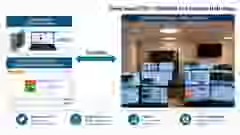
  • PTP support for synchronised video recording
image

System integration

Expanded system integration increases flexibility and supports more complex testing setups.

  • Integration with Fusion-LN 3180 modules 

image
  • Integration with Microstrain wireless sensors
image
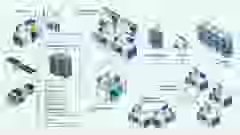
  • Support for distributed measurement setups 
image
  • Enhanced scalability for high channel count systems
image

Data handling improvements

New data handling capabilities improve flexibility and efficiency in managing measurement data.

  • Post-correction of sensor gain and sensitivity 

image
  • Convert analysis events into reference profiles
image

Why it matters

Tescia 2025.1 enables faster access to measurement data and earlier detection of issues during testing and monitoring.

It helps reduce test cycle time, minimise risk, and improve decision-making in high-cost and high-performance environments.

  • Performs measurements certain standards or similar qualification testing
  • Needs to perform frequency analysis on acoustic signals (Airborne, Structure borne)
  • Needs a solution that can be trusted, as there can be significant financial liability for inaccurate results
  • Any size company that measure & understand acoustic / vibration data from their plant and effects to their end-product
  • Might need a solution that can measure extremely low signal levels 
  • Running repeatable tests or long term measurements. 

Typical applications

  • Naval and SNMS monitoring 
  • Test cell environments 
  • Rotating machinery and turbine testing 
  • Structural and vibration monitoring

Related content