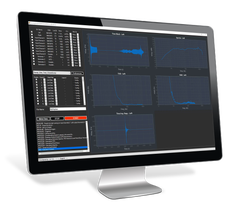

Production Test DAQ - 3670
Designed to be used with CCLD measurement transducers, that digitizes and streams data through a USB interface to computers running either macOS® or Windows® operating systems.
Read More

Smart glasses bring together open-ear speaker designs, microphones, and wireless connectivity, making audio testing significantly more demanding than with traditional wired headsets. Bluetooth transmission introduces latency and compression, while mixed digital and analog signal paths demand tighter control of synchronisation and calibration.
HBK’s Electroacoustic Engine (EA Engine) analysis software is designed to address these challenges. This guide provides a practical step-by-step overview of how to carry out reliable and repeatable audio quality measurements on smart glasses using the EA Engine, from initial setup to final analysis.
Compared with conventional audio devices, smart glasses introduce additional measurement challenges as a direct result of their wireless operation and hybrid signal paths.
The EA Engine is built to process and analyse both digital and analog signals within a single framework. It manages synchronisation, calibration, and equalisation across mixed inputs, using electroacoustic algorithms developed and validated by HBK. This allows measurements to be performed efficiently without compromising accuracy or repeatability, even in complex wireless test scenarios.
A typical setup includes:
The EA Engine is a fast, lightweight measurement framework with factory-verified electroacoustic algorithms. It supports both closed- and open-loop operation for testing Bluetooth®, USB, and other digital interfaces, and is compatible with standard Windows® audio interfaces including WDM, MME and WASAPI. Configuration is handled via XML and a full API, allowing integration into Python®, MATLAB® and Visual Studio environments (C#, VB.NET and others).
When paired with the USB DAQ Type 3670, the EA Engine acts as the central measurement system. This setup allows test developers to focus on their own algorithms or test sequences, while standard tasks such as time and channel synchronisation, microphone conditioning, signal generation and digital I/O handling are managed within the framework.
The measurement process is illustrated through a series of twelve videos, covering each stage from pairing and calibration to final test results. Together, they provide a detailed and practical walkthrough of a complete smart-glasses audio measurement workflow.
Establish the wireless connection between the smart glasses and the EA Engine.
Calibrate the reference microphone to ensure accurate and traceable results.
Define the output level used throughout the measurement process.
Apply equalisation to achieve a controlled, flat frequency response across the measurement bandwidth.
Route the digital test signal into the EA Engine to drive the device under test.
Configure the swept sine test, including frequency range, duration, and level for fast and precise measurements.
Define and attach metadata such as device ID, test conditions, operator, and configuration to ensure traceability and proper documentation.
Measure frequency response, distortion, and other key performance metrics.
Add tolerance limits and target curves to automatically evaluate pass or fail criteria.
Review and export measured data.
Repeat the speaker measurement for the right channel.
Measure the performance of the microphone integrated into the smart glasses.
By combining automated calibration, synchronisation and standardised test sequences in a single workflow, the EA Engine simplifies audio testing for modern smart devices. From initial pairing through to final results, each step is designed to reduce setup time and operator effort, enabling reliable speaker and microphone measurements in minutes rather than hours.
With consistent processing, metadata handling, and tolerance checking, the same workflow can be applied to quick engineering evaluations or more structured pass/fail testing. The result is repeatable, traceable audio measurement across devices and test runs, even in the presence of wireless transmission and mixed signal paths.
Designed to be used with CCLD measurement transducers, that digitizes and streams data through a USB interface to computers running either macOS® or Windows® operating systems.

Electroacoustic data acquisition and analysis engine for use with Type 3670 DAQ that can be programmed to produce user defined, automated test applications
This will bring together HBM, Brüel & Kjær, nCode, ReliaSoft, MicroStrain and Discom brands, helping you innovate faster for a cleaner, healthier, and more productive world.
