


Die Inertialmesseinheit (IMU) und das Lage- und Kursreferenzsystem (AHRS) 3DM-CV7-AHRS bieten taktischer Güteklasse Leistungsfähigkeit im kleinsten und leichtesten OEM-Paket aller Zeiten. Jeder Sensor wird individuell kalibriert, um unter verschiedensten Betriebsbedingungen optimale Leistung zu gewährleisten.
Unser selbstadaptiver erweiterter Kalman-Filter wurde von Grund auf so konzipiert, dass er auch in anspruchsvollsten Umgebungen konstant zuverlässige Messungen liefert. Modernste Orientierungsalgorithmen, ein fortschrittliches internes Zeitmanagement und ein flexibles Ereignisauslösesystem heben den 3DM-CV7-AHRS in puncto Preis und Leistung deutlich hervor.

3DM-CV7-AHRS
Taktisches Gyroskop (1,5°/h Bias-Instabilität)
Vollständig kalibriert über den gesamten Temperaturbereich
Statische Genauigkeit in Nick- und Rollwinkel : 0,25°, dynamische Genauigkeit: 0,5°
Integriertes Magnetometer zur absoluten Kursverfolgung
Integrierter Extended-Kalman-Filter zur Lagebestimmung
Vom Benutzer wählbarer Beschleunigungsmesser- und Gyroskopbereich
1 kHz Ausgabedatenrate für alle Kanäle
Werkseitig unterstützte ROS1- und ROS2-Treiber
PX4 Autopilot-Treiber für Drohnen, Rover, Roboter und mehr
SensorConnect Software für Konfiguration, Steuerung, Anzeige und Protokollierung
MSCL Open-Source- API für einfache Integration
Montagefuß aus eloxiertem Aluminium
Präzise Ausrichtungsfunktionen
Kompakt und flach
38 mm x 24 mm x 8,6 mm
8,3 Gramm
18 % dünner als die 3DM-CV5-Serie
20 % leichter als die 3DM-CV5-Serie
USB- und UART (TTL)-Schnittstelle
Die identische Bauform zur 3DM-CV5-Serie ermöglicht einfache Upgrades.
–40 bis +85°C Betriebstemperaturbereich
| Document | Typ | Sprache |
|---|---|---|
| 3DM-CV7 Series Data Sheet | Datenblätter | English |
| Micro-D to RS232 Communication and Power Cable | Accessory Guide | English |
| 6212-3010 DEVELOPMENT KIT, RS232, INERTIAL C-SERIES | Accessory Guide | English |
| 6212-3009 DEVELOPMENT KIT, USB, INERTIAL C-SERIES | Accessory Guide | English |
| Craft Cable with Micro DB9 and Flying Leads | Accessory Guide | English |
| Micro D-to-USB Communication and Power Cable | Accessory Guide | English |
| 3DM-CV7 - Bedienungsanleitung (online) | Bedienungsanleitung | English |
| C-Series Connectivity Board Interface Control Document | Montageanleitung | English |
| GV7-CV7 Firmware Change Log | Versionshinweise | English |
Certificates and Approvals
| Document | Typ | Sprache |
|---|---|---|
| 3DM-CV7 Declaration of Conformity (EU) | Konformitätserklärung | English |
| 3DM-CV7 Declaration of Conformity (UK) | Konformitätserklärung | English |
| Document | Typ |
|---|---|
| 3DM-CV7 CAD Model | CAD-Dateien (STEP) |
| MicroStrain 7-Series Inertial Sensor Firmware | Firmware |
| Eigenschaft | Wert |
|---|---|
| Type | Attitude & Heading (AHRS) |
| Performance Grade | Tactical Grade |
| Features | Accelerometer, Gyroscope, Magnetometer |
| Random Walk | Accel: 20 µg/√Hz, Gyro: 0.3 °/√hr |
| Bias Instability (Gyroscope) | 1.5 °/hr |
| Bias Instability (Accelerometer) | 18 μg |
| Hysteresis | Accel bias: 0.6 mg, Accel gain: 125 PPM, Gyro bias: 0.04 °/s, Gyro gain: 1000 PPM |
| Communication Port Type | Samtec FTSH series |
| Communication Interface | TTL serial, USB |
| Update Rate | IMU: 1000 Hz, EKF: 1000 Hz |
| Inputs/Outputs | 4xGPIO |
| Weight | 8.3 g |
| Weight | 0.293 oz |
| Size | 38 mm x 24 mm x 8.6 mm |
| Size | 1.50 in x 0.94 in x 0.34 in |
| Power Consumption | 0.23 W |
| Input Voltage | 3.2 V to 5.2 V |
| Minimum Operating Temperature | -40 °C |
| Maximum Operating Temperature | 85 °C |
| Minimum Operating Temperature | -40 °F |
| Maximum Operating Temperature | 185 °F |
| MTBF | 2002026 h |
| Sensing Range (Accelerometer) | 4 g |
| Sensing Range (Gyroscope) | 250 °/s |
| Sensing Range (Magnetometer) | 8 Gauss |
| Sensing Range (Pressure) | 1260 mbar |
| Accuracy | Roll/Pitch (dynamic): 0.5 °, Roll/Pitch (static): 0.25 °, Heading (static): 0.5 °, Heading (dynamic): 2 ° |
| Ingress Protection Rating | Not Rated |
| Housing Material | Aluminum |
| Software | MSCL, ROS, SensorConnect |
| Mounting Style | Embeddable, Screw Down, Precision Alignment |
Access your sensor's comprehensive online user manual. Find detailed setup instructions, calibration procedures, troubleshooting guides, and technical specifications all in one convenient location.
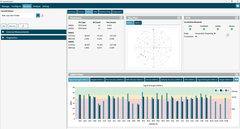
InertialConnect is the latest software solution for MicroStrain inertial sensors. With InertialConnect, you can easily configure your sensors, adjust parameters, upgrade firmware, and deploy preconfigured parameter files. You can also verify sensor outputs with intuitive visualizations, including times eries data, position data, and statuses.
InertialConnect is compatible with both PC desktop and Linux operating systems, making it your go-to solution for precision and efficiency in inertial sensor management.

SensorConnect is the next generation in desktop sensing software.
From configuration of nodes and starting networks, to collecting and analyzing data in real-time, SensorConnect provides a modern, powerful experience with our Wireless, Inertial, and Displacement products.
Using our intelligent data collection and graphing algorithms, you are able to visualize massive amounts of data instantly, and then zoom in on points of interest just as fast.
Built in MathEngine functionality allows for both real-time and post-processed math, such as generating FFTs, averages, RMS, etc.
SensorCloud is a unique sensor data storage, visualization, and remote management platform that leverages powerful Cloud computing technologies to provide excellent data scalability, rapid visualization, and user programmable analysis.
MicroStrain sensors can instantly upload their data to SensorCloud via an ethernet-connected WSDA-2000. Once uploaded, your data is securely stored in the Cloud and can be accessed from anywhere, or downloaded for offline use.
Configurable alerts can be set to help notify you of real-time event in your data.
MathEngine allows you to perform analytics on your data, all in the Cloud. Pre-built functions are available for ease of use, while IPython Notebooks allow advanced users to write custom scripts to be run on their data once, or on a schedule.
The MicroStrain Communication Library (MSCL) is our open-sourced API that simplifies writing code to interact with our sensors. MIP SDK is a lightweight C/C++ library for interacting with MicroStrain G and C-series products via baremetal and resource constrained microcontrollers.
Both APIs are readily available and fully-documented on GitHub, featuring valuable tools such as full documentation, example code, and a quick start guide.
Robot Operating System (ROS) is an open-source, meta-operating system for your robot. It provides the services you would expect from an operating system, including hardware abstraction, low-level device control, implementation of commonly-used functionality, message-passing between processes, and package management. ROS can be used in building and simulating robotics applications, as well as unmanned ground vehicles and simultaneous localization and mapping (SLAM). MicroStrain has an open source License free (MIT License) series of drivers specifically designed and tested for ROS.
PX4 is an open source flight control software for drones and other unmanned vehicles. The project provides a flexible set of tools for drone developers to share technologies to create tailored solutions for drone applications. PX4 provides a standard to deliver drone hardware support and software stack, allowing an ecosystem to build and maintain hardware and software in a scalable way. PX4 is fully supported on MicroStrain’s 3DM-CV7 family of inertial sensors.


Dies vereint die Marken HBM, Brüel & Kjær, nCode, ReliaSoft und Discom und ermöglicht es Ihnen, schneller Innovationen für eine sauberere, gesündere und produktivere Welt zu schaffen.

Dies vereint die Marken HBM, Brüel & Kjær, nCode, ReliaSoft und Discom und ermöglicht es Ihnen, schneller Innovationen für eine sauberere, gesündere und produktivere Welt zu schaffen.

Dies vereint die Marken HBM, Brüel & Kjær, nCode, ReliaSoft und Discom und ermöglicht es Ihnen, schneller Innovationen für eine sauberere, gesündere und produktivere Welt zu schaffen.
Dies vereint die Marken HBM, Brüel & Kjær, nCode, ReliaSoft und Discom und ermöglicht es Ihnen, schneller Innovationen für eine sauberere, gesündere und produktivere Welt zu schaffen.

Dies vereint die Marken HBM, Brüel & Kjær, nCode, ReliaSoft und Discom und ermöglicht es Ihnen, schneller Innovationen für eine sauberere, gesündere und produktivere Welt zu schaffen.
 6212-3006
 6212-3009
 6212-3010