


Le 3DM-GQ7-GNSS/INS est un système de navigation inertielle assistée par GNSS à double antenne de niveau tactique qui offre une précision de positionnement de l'ordre du centimètre grâce à des corrections RTK et à une fusion de capteurs étroitement couplée via un filtre de Kalman étendu avancé.
Il est équipé de deux récepteurs GNSS multibandes, de capteurs inertiels MEMS à faible dérive et offre une mesure de cap robuste, insensible aux perturbations magnétiques, ce qui en fait la solution idéale pour les systèmes autonomes et la robotique dans des environnements difficiles.

3DM-GQ7-GNSS/INS
Le MicroStrain 3DM-GQ7-GNSS/INS est une solution de navigation tout-en-un offrant une précision de positionnement de l'ordre du centimètre. Il s'agit de notre premier système INS à double antenne compatible RTK, conçu pour offrir des performances exceptionnelles, même dans des conditions imprévisibles. Il est équipé de deux récepteurs GNSS multibandes, de capteurs inertiels MEMS à faible bruit et à faible dérive, ainsi que d'un filtre de Kalman adaptatif robuste.
Associé à notre Modem 3DM-RTK et à notre service de corrections RTK SensorCloud, le 3DM-GQ7-GNSS/INS constitue la meilleure solution de navigation RTK proposée par un seul fournisseur.
Précision de positionnement jusqu'à 1 cm + 1 ppm avec RTK
Prend en charge les corrections cinématiques en temps réel (RTK) RTCM standard
Aluminium anodisé
Certificates and Approvals
| Document | type | langue |
|---|---|---|
| 3DM-GQ7 Declaration of Conformity (EU) | Déclaration de Conformité | English |
| 3DM-GQ7 Declaration of Conformity (UK) | Déclaration de Conformité | English |
| Document | type |
|---|---|
| 3DM-GQ7-GNSS/INS CAD File | CAD Step Files |
| 3DM-GQ7-GNSS/INS Firmware | Firmware |
| propriété | valeur |
|---|---|
| Type | Inertial Navigation (INS) |
| Performance Grade | Tactical Grade |
| Features | Accelerometer, Gyroscope, Magnetometer |
| Random Walk | Accel: 20 µg/√/Hz, Gyro: 0.15 °/√hr |
| Bias Instability (Gyroscope) | 1.5 °/hr |
| Bias Instability (Accelerometer) | 5 μg |
| Hysteresis | Accel bias: 0.4 mg, Accel gain: 600 PPM, Gyro bias: 0.3 °/s, Gyro gain: 1000 PPM |
| Communication Port Type | 2 x Micro D9 |
| Communication Interface | RS-232, USB |
| Update Rate | IMU: 1000 Hz, EKF: 1000 Hz, GNSS: 2 Hz |
| Inputs/Outputs | 4xGPIO |
| Weight | 78 g |
| Weight | 2.751 oz |
| Size | 76 mm x 68.6 mm x 13.3 mm |
| Size | 2.99 in x 2.70 in x 0.52 in |
| Power Consumption | 2.2 W |
| Input Voltage | 4.2 V to 16 V |
| Minimum Operating Temperature | -40 °C |
| Maximum Operating Temperature | 85 °C |
| Minimum Operating Temperature | -40 °F |
| Maximum Operating Temperature | 185 °F |
| MTBF | 389237 h |
| GNSS Constellations | GPS/QZSS, GLONASS, Galileo, BeiDou |
| GNSS Frequency Bands | L1C/A, L2C, L10F, LSOF, E1B/C, E5B, B1, B2 |
| GNSS Input(s) | Onboard Receiver(s) |
| Sensing Range (Accelerometer) | 8 g |
| Sensing Range (Gyroscope) | 300 °/s |
| Sensing Range (Magnetometer) | 8 Gauss |
| Sensing Range (Pressure) | 1260 mbar |
| Accuracy | Horizontal Position (single point): 1.25 m, Vertical Position (single point): 2 m, Horizontal Position (RTK): 0.02 m, Vertical Position (RTK): 0.02 m, Velocity accuracy (single point): 0.1 m/s, Velocity accuracy (RTK): 0.05 m/s, Roll/Pitch: 0.05 °, Heading (dual antenna): 0.25 ° |
| Ingress Protection Rating | Not Rated |
| Housing Material | Aluminum |
| Software | MSCL, ROS, SensorConnect |
| Mounting Style | Screw Down, Precision Alignment |

Accédez au manuel d'utilisation complet en ligne de votre capteur. Retrouvez en un seul endroit des instructions d'installation détaillées, des procédures d'étalonnage, des guides de dépannage et des spécifications techniques.
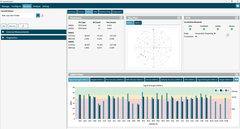
InertialConnect is the latest software solution for MicroStrain inertial sensors. With InertialConnect, you can easily configure your sensors, adjust parameters, upgrade firmware, and deploy preconfigured parameter files. You can also verify sensor outputs with intuitive visualizations, including times eries data, position data, and statuses.
InertialConnect is compatible with both PC desktop and Linux operating systems, making it your go-to solution for precision and efficiency in inertial sensor management.

SensorConnect is the next generation in desktop sensing software.
From configuration of nodes and starting networks, to collecting and analyzing data in real-time, SensorConnect provides a modern, powerful experience with our Wireless, Inertial, and Displacement products.
Using our intelligent data collection and graphing algorithms, you are able to visualize massive amounts of data instantly, and then zoom in on points of interest just as fast.
Built in MathEngine functionality allows for both real-time and post-processed math, such as generating FFTs, averages, RMS, etc.

SensorCloud is a unique sensor data storage, visualization, and remote management platform that leverages powerful Cloud computing technologies to provide excellent data scalability, rapid visualization, and user programmable analysis.
MicroStrain sensors can instantly upload their data to SensorCloud via an ethernet-connected WSDA-2000. Once uploaded, your data is securely stored in the Cloud and can be accessed from anywhere, or downloaded for offline use.
Configurable alerts can be set to help notify you of real-time event in your data.
MathEngine allows you to perform analytics on your data, all in the Cloud. Pre-built functions are available for ease of use, while IPython Notebooks allow advanced users to write custom scripts to be run on their data once, or on a schedule.

SensorCloud RTK is a multi-continent, IP-based RTK cloud network that delivers centimeter-level position accuracy from day one without complex setup, featuring network coverage across the U.S., Europe and beyond.
When paired with compatible MicroStrain navigation systems, it offers seamless scalability from development to production with professional technical support throughout.
The MicroStrain Communication Library (MSCL) is our open-sourced API that simplifies writing code to interact with our sensors. MIP SDK is a lightweight C/C++ library for interacting with MicroStrain G and C-series products via baremetal and resource constrained microcontrollers.
Both APIs are readily available and fully-documented on GitHub, featuring valuable tools such as full documentation, example code, and a quick start guide.
Robot Operating System (ROS) is an open-source, meta-operating system for your robot. It provides the services you would expect from an operating system, including hardware abstraction, low-level device control, implementation of commonly-used functionality, message-passing between processes, and package management. ROS can be used in building and simulating robotics applications, as well as unmanned ground vehicles and simultaneous localization and mapping (SLAM). MicroStrain has an open source License free (MIT License) series of drivers specifically designed and tested for ROS.
Le 3DM-GQ7-GNSS/INS est un système de navigation inertielle (INS) de qualité tactique avec une capacité de système mondial de navigation par satellite (GNSS) intégrée. Il combine deux récepteurs GNSS multibandes avec des capteurs inertiels haute performance et un positionnement cinématique en temps réel (RTK) pour fournir une précision de position au centimètre près pour les applications de navigation autonome.
La cinématique en temps réel (RTK) est une technique de navigation par satellite qui offre une précision de positionnement au centimètre près en utilisant des données de correction provenant d'une station de référence. La capacité RTK native du 3DM-GQ7-GNSS/INS permet un positionnement précis pour les applications exigeant une haute précision comme l'agriculture de précision, la topographie et la navigation des véhicules autonomes.
SensorCloud RTK est le réseau cloud RTK multicontinental basé sur IP de HBK qui offre une précision centimétrique sans configuration complexe de station de base. Associé au modem 3DM-RTK, il offre des corrections RTK transparentes et prêtes à l'emploi aux États-Unis, en Europe et au-delà, avec un support technique professionnel.
Le GNSS à double antenne utilise deux antennes distinctes pour déterminer la direction du cap avec une précision de 0,25° insensible aux perturbations magnétiques. Ce système fournit des informations de cap fiables même dans des environnements présentant des interférences magnétiques, ce qui le rend supérieur aux systèmes de cap basés sur un magnétomètre.
Le 3DM-GQ7-GNSS/INS est idéal pour :
Oui, l'IMU de qualité tactique avec une instabilité de biais <2°/h offre une précision de position exceptionnelle lors des interruptions GNSS. Le filtre de Kalman étendu auto-adaptatif robuste maintient la capacité de navigation lorsque les signaux satellites sont indisponibles ou dégradés.
Absolument. Le système dispose de fréquences d'échantillonnage réglables jusqu'à 1 kHz et d'un filtre de Kalman étendu à couplage étroit de pointe, conçu pour des performances exceptionnelles dans des conditions dynamiques, ce qui le rend idéal pour les plateformes à déplacement rapide et les applications à forte accélération.
Oui, MicroStrain fournit des pilotes ROS open source sous licence MIT, spécialement conçus et testés pour le 3DM-GQ7-GNSS/INS, permettant une intégration transparente avec les applications robotiques et les systèmes autonomes basés sur ROS.
Le filtre de Kalman étendu auto-adaptatif est un algorithme de fusion de capteurs avancé qui s'adapte automatiquement aux conditions et à la dynamique environnementales changeantes. Il assure une intégration étroite des données GNSS et inertielles, garantissant des performances optimales et un rejet robuste des anomalies dans des conditions difficiles.
Le système utilise des récepteurs multi-constellations dotés chacun de 184 canaux de suivi pour un suivi robuste du signal, un cap à double antenne insensible aux interférences magnétiques, des performances IMU de qualité tactique et des algorithmes avancés qui offrent des performances dynamiques exceptionnelles et un rejet automatique des anomalies.
Le 3DM-GQ7-GNSS/INS offre des performances tactiques de très haute précision dans un format compact de 78 grammes, avec une capacité RTK native, un cap à double antenne et une solution complète d'un seul fournisseur incluant des corrections RTK basées sur le cloud - des fonctionnalités que l'on ne trouve généralement que dans des systèmes beaucoup plus grands et plus coûteux.
Oui, faisant partie de la gamme de produits MicroStrain de HBK, le 3DM-GQ7-GNSS/INS est conforme à la loi NDAA, ce qui le rend adapté aux applications gouvernementales et de défense américaines.
 6285-0100
 6212-3018
 6212-3020
 6212-3021
 6212-3022
 6224-0100