Requirements for the measuring chain
A measuring chain comprises at least a charge amplifier and a sensor - this can be a calibrated transducer or a force washer (
CFW,
CLP) as well as a piezoelectric strain sensor (
CST). Connecting the piezoelectric sensors in parallel is relatively simple using the above mentioned summing box. The cables too need to meet specific requirements. These include a very high insulation resistance, freedom from noise even under motion and mechanical strength. Special coaxial cables comply with these conditions. When mounting the sensor it is necessary to ensure that it is normally mounted onto a metal part. Hence the sensor's enclosure is also electrically connected to the object on which the force sensor is mounted.
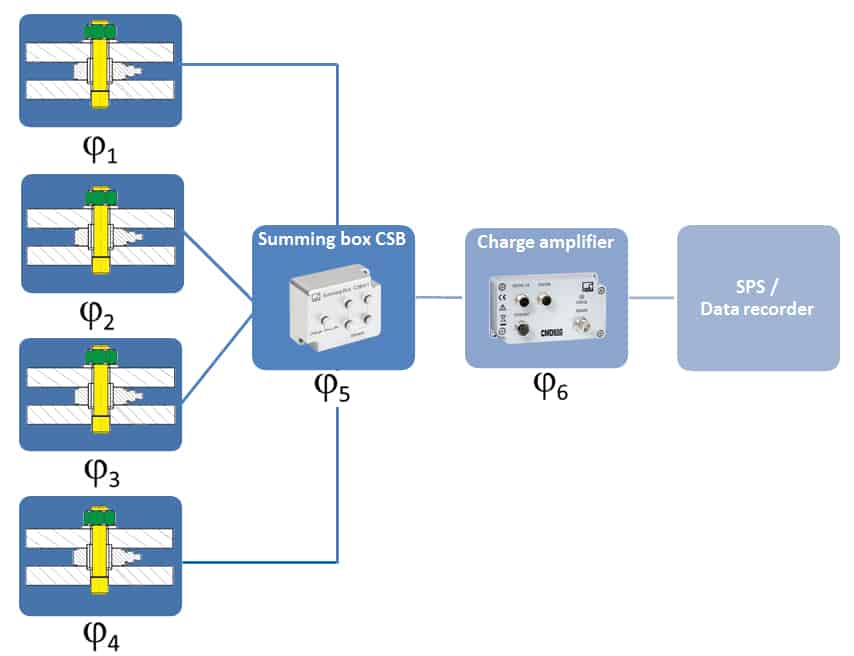
Fig. 1 shows a measuring chain comprising four sensors connected to a charge amplifier by a summing box. The sensors are mechanically connected. Since force application parts from hardened steels are used in force measurement technology, the enclosures too have the same electric potential.
Avoiding interference effects
In practice, it is often the case that the summing box or charge amplifier are mounted such that they have a different electric potential. With the summing box and charge amplifier enclosures being connected to the coaxial cable's shielding and thus to the sensor's enclosure, there are compensating currents flowing through the cable shield when the electric potentials differ. These compensating currents may possibly interfere with the measurement.
Using plastics parts for electrically separating summing boxes or charge amplifiers from the objects onto which they are mounted is state-of-the-art technology. The circuit is interrupted, no compensating currents can flow. However, there are two disadvantages: On the one hand, the technician must remember to order insulating washers. On the other hand, mounting is complicated.
This is not necessary with Paceline products: Metal (charge amplifier, summing box) can be screwed onto metal (control cabinet, industry-standard rail), since there is no electrical connection between cable shield and enclosure. This facilitates mounting.