변형률
변형률 게이지(변형계)는 더 우수하고 안전한 제품을 만들기 위해 재료의 피로도를 측정하고 시험하는 데 있어 핵심적인 도구입니다. 구조적 내구성 테스트,구조 상태 모니터링, 또는 OEM 트랜스듀서 생산을 위해, HBK의 광학 및 전기 스트레인 게이지를 첫 번째로 선택해야합니다.
Read More

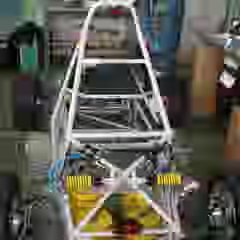


The Lessius Racing Team (LRT), a group of enthusiastic students from Lessius Mechelen | Campus De Nayer, is taking part in the Formula Student Competition, an educational competition requiring students to build a race car prototype as a team, and then sell it. The mission of the Formula Student competition is to encourage young people to step into the technical business world, challenging them to design, build, finance, present, and compete as a team with a small, single-seat race car in a series of static and dynamic events. LRT is participating in the 1A class, meaning they will develop new and novel powertrain technologies that result in race cars with low carbon emissions, as defined by the Class 1A rules.
A crucial part of designing an efficient race car is the suspension system. It plays a part in reducing both weight and friction, optimizing vehicle performance. To reduce not only the total weight of the race car, but also the so-called unsprung mass, as little material as possible has to be used in the construction of the suspension system. A low unsprung mass is important, to ensure fast response of the suspension system to bumps and potholes, maintaining constant contact of the tires with the racetrack, and providing maximum vehicle control. The stiffness of the suspension is another important part, as deformation in the suspension would influence the geometry of the car setup (such as caster, camber, and toe), which would adversely affect handling and rolling friction. In addition, the suspension has to handle all the forces acting on the race car to keep it on track when turning into corners at high speed.
To ensure the maximum weight reduction does not affect the structural strength, modern finite element (FE) simulation packages have been used in the design. Only one link in the chain for developing a sturdy, but lightweight, suspension was missing: validation of the FE models to ensure the models and the design are correct. This validation, offering certainty about the design that the team was looking for, has been achieved by applying strain gages to different suspension parts. The choice was made to perform a test with direct loading by putting weight on the vehicle while measuring the force actually acting on the full suspension with weighing plates under the wheels.
The measured forces acting on the wheels were used as input parameters for the FE model simulation to correlate the material deformation measured by the strain gauges with the corresponding locations in the FE model. This approach offers a well-defined test scenario that simplifies the correlation of simulated and measured data. The next step is to instrument the race car with further data-acquisition equipment to perform measurements in real-life use cases actually driving the vehicle on a race track. This has already been discussed, and will be an assignment for next year's racing team. For now, the static tests have proven to be a great success, and ensured structural stability of the current suspension design. Further dynamic tests will help the team minimize the weight and increase the vehicle performance without risking component failure or vehicle misbehavior due to a lack of structural stiffness.
변형률 게이지(변형계)는 더 우수하고 안전한 제품을 만들기 위해 재료의 피로도를 측정하고 시험하는 데 있어 핵심적인 도구입니다. 구조적 내구성 테스트,구조 상태 모니터링, 또는 OEM 트랜스듀서 생산을 위해, HBK의 광학 및 전기 스트레인 게이지를 첫 번째로 선택해야합니다.

교정, 재료 또는 피로 테스트 여부에 관계없이 MGCplus 데이터 수집 시스템은 모든 종류의 애플리케이션에서 사용됩니다. 변형, 힘, 변위, 토크, 전압, 전류, 온도 및 기타 많은 매개변수에 대한 데이터를 수집합니다. 이러한 다재다능성 덕분에 MGCplus는 전 세계에서 가장 인기 있는 데이터 수집 시스템 중 하나입니다.