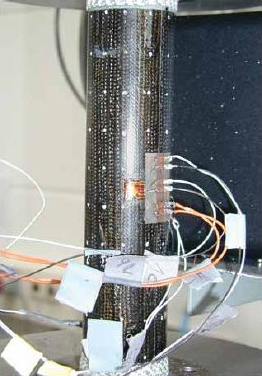
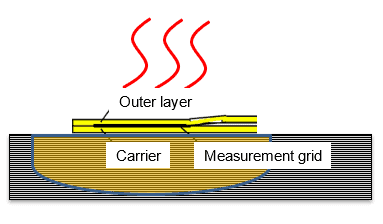
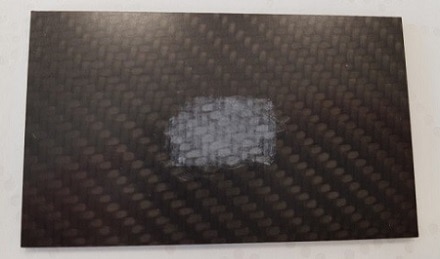
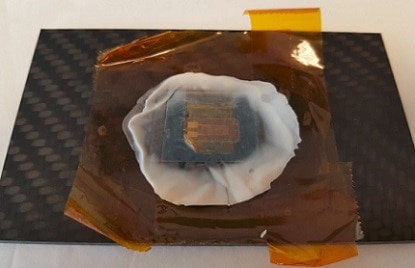
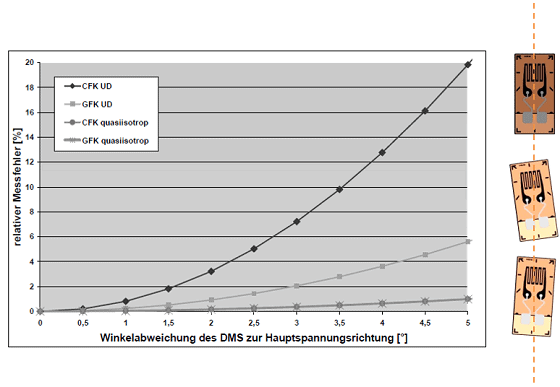
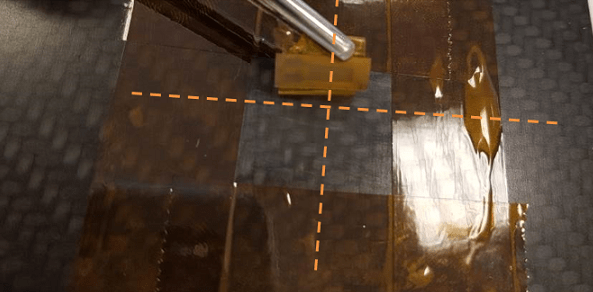
A strain gauge integrates the strain below the surface, and an average strain is measured.
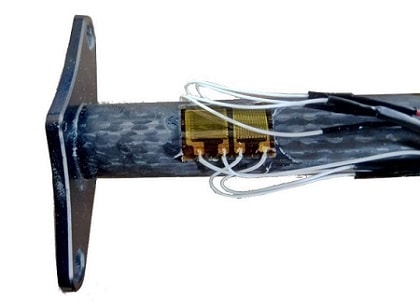
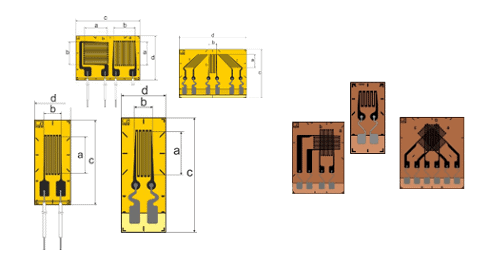
The right measuring grid length depends on the testing objective. Grid lengths of 6 mm and 10 mm are popular solutions for strain measurements on composites.
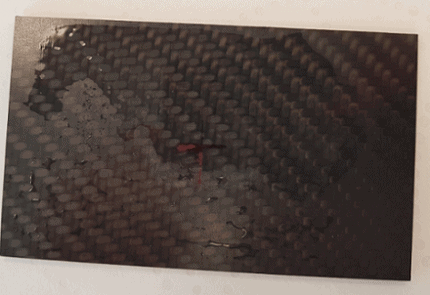
On principle, the same rule applies for selecting the strain gauges as for concrete: The strain gauge length should exceed the fiber distance by at least factor 5. The strain gauge width should also cover several fibers.
Local strain peaks can occur due to material inhomogeneities. In this case, strain gauge chains can be used to determine the strain gradient.
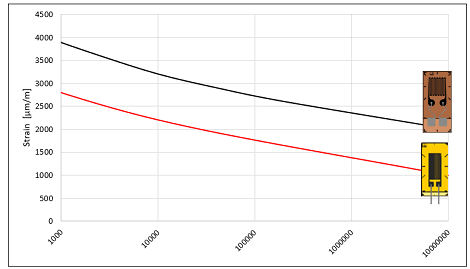
Often, the stress peaks between the fibers are a multiple of the average strain. As a consequence, the strain gauge may be overloaded at some points, its maximum elongation being reached or exceeded, although the amplifier displays a far smaller strain. Thus, there is a risk of the SG being overloaded (permanently damaged) at individual points or of failure of the whole installation. This problem can be eliminated by inserting a thin Polyimide film between the strain gauge and the workpiece. The film is glued between the component and the strain gauge and performs preliminary integration, i.e., it "distributes" the stress peaks under the strain gauge measuring grid. Because of the resulting thicker layers, the film should only be used if a high strain is expected.