Electrical Connection of Force Transducers
En savoir plus


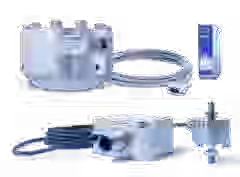
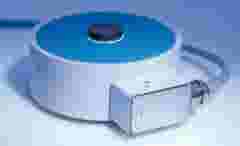
In this article, Thomas Kleckers, Product Manager Force Sensors at HBM, explains how a force transducer works.
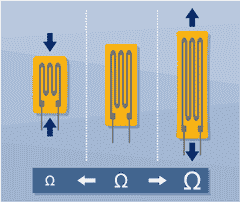
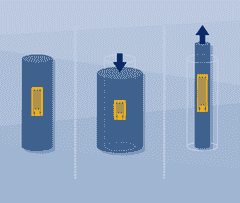
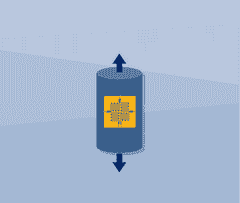
"When it is pulled, things don't just get longer, they also get thinner. Poisson's ratio indicates the ratio of transverse to axial strain. We can compare this with a rubber band, which becomes noticeably thinner when it is stretched." – Thomas Kleckers
In principle, they both seem really similar: the load cell measures mass or weight, the force transducer measures force (i.e. N, or Newtons). Surely they are almost interchangeable? Simply enter 100 grams of weight for each Newton, and you can turn a force transducer into a load cell! But it's not that simple.
The load cell measures mass, and only ever in one direction, because the mass is always greater than 0. If a container is placed on a load cell, this cannot suddenly lift itself up and produce a negative weight. The force transducer, on the other hand, measures negative and positive forces, tensile and compressive forces.
The load cell is produced then installed somewhere or other at the user's plant, then calibrated on site. Force transducers are calibrated at the factory immediately following production, and must always measure the same, even if removed and installed several times. The force transducer therefore has a more robust construction than most load cells, in order to guarantee the reproducibility of the measured values under varying conditions.
The load cell must satisfy certain legal requirements, regarding legal-for-trade capability, for instance. The force transducer fulfills different regulations – standards, such as VDI 2635 or ISO 376. Unlike the load cell, the above-mentioned reproducibility, for example, is an important factor.
"Force transducers are used virtually everywhere – it's hard to imagine. I was particularly impressed by one test bench usage whereby a force was measured across an air gap. In other words, measurement is taking place even though the force transducer is not touching the platform. I still find it incredible today that this actually works" – Thomas Kleckers
To conclude, we'll take a look at business – a few fields where force transducers are used.